Told Me I d Never Run Again Torn Cartilage
Knees put upwardly with a huge amount of strain during most types of activity. So what are the most effective treatments when running injuries occur?
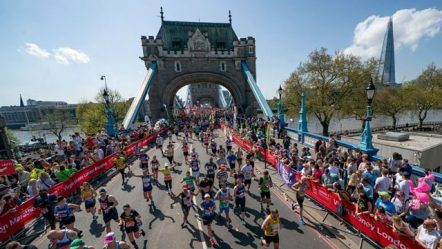
Running is adept, if your knees are up to it
Some people similar to run. If you've got the genetics of Mo Farah then you could probably run thousands and thousands of miles, and every bit long as y'all're lucky, your knees would probably be fine. We've all heard the inquiry headlines that running is good for your knees and that it doesn't cause arthritis. Merely is that really truthful, and does it really apply to the states all?
If y'all've got normal tyres on your car, then you lot tin drive prissy and fast for practiced long distances. If your tyres are bald, then yous might get a blowout. If your car'south stupor absorbers are knackered and if yous drive at speed forth cobbles, and then your motorcar will probably fall apart, etc. etc.
The analogy for knees really isn't all that unlike.
If you're overweight, either through obesity or because of your natural shape because of your genetics, then you're simply not 'built' for running.
If your meniscal cartilages are torn or missing, then y'all've lost your shock absorbers, and you're only no longer suited to running.
If your articular cartilage is wearing thin or if it's worn abroad down to bare bone, and if y'all so run, you're simply going to cause more damage.
And then the list goes on.
So, running with normal knees is good, but running on bad knees is bad, and it's quite bluntly just silly!
Runners are a funny lot!
Most people who run regularly share a number of particular traits:
- they're commonly skinny
- they are fit
- they accept more than free energy
- they are more positive, and take a lower incidence of depression
- they love running
- they are obsessed!
They are obsessed with running, but they also obsess with all the many things that are associated with running, including:
- footwear
- running mode
- diet
- supplements
- lycra!

And what's the best way to make a runner hate you (or at the very least, stop listening to yous and ignore all your skilful advice): tell them to stop running!
The positives of running
The list is long, and information technology includes:
- reduced risk of heart attack
- reduced risk of stroke
- reduced take chances of diabetes
- reduced incidence of depression
- reduction in stress
- improved cognitive part and memory processing and storage
- higher pain threshold
- living longer and living better!
On top of all this, running is cheap and convenient.
Runners tin actually experience somewhat cleverly smug almost things, every bit the inquiry is actually in their favour. Nokia et al published a written report in The Periodical of Physiology in 2022 looking at the effects of exercise on rats. 88 rats were taken and split into groups:
- 1) Sedentary
- two) Weight-lifting
- 3) HIIT training
- 4) Long distance running
They studied the amount of Encephalon Derived Neurotrophic Factor (BDNF) released from each rat's hippocampus in the brain. BDNF has been shown to increase the number of neurones in the hippocampus, and it is the hippocampus that aids in the storage of new memories, keeps new and sometime memories distinct, allows flexibility in the use of existing memories and assists the processing of new data (i.e. the hippocampus is kind of of import, if y'all want to avoid depression and anxiety and if you desire to meliorate mental performance).
The rats were examined later on 7 weeks of exercise, and Nokia et al.'s results showed the post-obit:
- No change in the sedentary group.
- The weight-training group gained muscle mass and strength, just there was no increment in BDNF.
- The HIIT group showed some increase in BDNF.
- The biggest increment in BDNF by far was in the runners! – and the greater the running distances, the bigger the increment in BDNF.
Therefore, running is actually skillful for your brain, non just your overall physical health.

And then, it actually can take quite a lot for someone like me to propose someone who runs to 'non run'!
The near of import thing is to mind to your trunk and to listen to your knees. For muscles, it's true: no pain, no gain. However, for joints it'due south the opposite. If your human knee hurts then this is a sign that there'southward a trouble, and like many problems in life, the longer you lot ignore them with your head buried in the sand, the worse they get.
There are iii broad categories of knee joint problems that I see in runners, and these are:
- 1) Over-use 'injuries', where the pain is coming from tissue inflammation.
- two) Traumatic damage, where a specific construction in the knee is damaged.
- iii) 'Wear and tear', progressing from early degenerative changes to fully-blown arthritis.
Over-apply injuries
This is where something is either rubbing, or where the tissues merely aren't able to cope with the stresses that are existence placed on them, which tips the balance into negative in the ongoing damage-repair cycle.
This group includes conditions such as:
- ITB Friction Syndrome
- patellar tendinopathy
- medial plica syndrome
- fat pad inflammation
Broadly speaking, the all-time direction of these conditions is:
- (i) Come across a specialist.
- (ii) Take advisable imaging with an MRI + likewise an ultrasound scan, to A) ostend the diagnosis, but besides B) to double bank check for whatsoever other potential intra-articular pathology.
- (three) Residual!
- (4) Take anti-inflammatories and endeavour icing the knee.
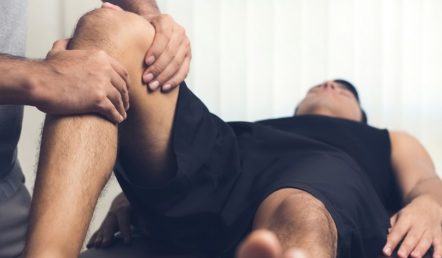
- (v) Manual therapy.
- (vi) And so, if things still fail to settle, one can then consider other non-invasive treatment options, such as ultrasound-guided injections or shockwave therapy – and these normally fall nether the remit of our colleagues, the Consultants in Sport & Exercise Medicine.
In these weather, surgery is simply rarely always necessary.
Traumatic injuries
Fortunately, nosotros see relatively lilliputian knee joint trauma in runners. It's adequately rare for a runner to trip and fall and end upwardly accidentally twisting their genu and causing major damage, such every bit ligament ruptures. However, one blazon of trauma that I exercise see on occasions is traumatic patellofemoral articular cartilage impairment.
If a runner falls, and if they autumn forwards landing on the fronts of their knees on hard concrete, then this exerts massive blunt trauma to the front end of the knee, with impaction of the patella onto the front end of the trochlear groove at the front end of the femur.
If there's a haematoma in the soft tissue at the front end of the knee, or pre-patellar bursitis, this can be extremely painful, but these bug are just superficial and they unremarkably tend to settle downward on their own, mostly without the need for specific intervention.
<a proper name="Traumatic" injuriesIf, however, there is astringent enough compressive blunt trauma to the articular cartilage in the patellofemoral articulation at the forepart of the knee, and then this tin can sometimes cause acute impairment to the articular cartilage (which will normally testify up on an MRI browse). This tin can sometimes need early surgery.
If, however, an MRI scan shows significant patellofemoral bone bruising but no actual articular cartilage damage, so this may non really be as genuinely reassuring as i might first think – because even if the articular cartilage initially remains intact, it can endure delayed failure afterwards: sometimes months or even years later. Therefore, this kind of injury is certainly one to take seriously.
'Wear and tear'
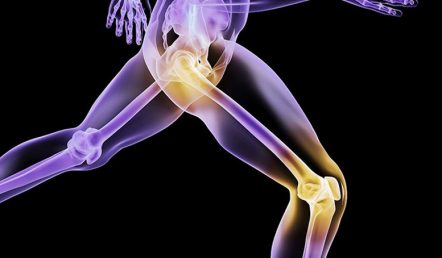
The primary things that 'wear' in a knee joint are:
- the meniscal cartilages
- the articular cartilage
Meniscal tears
The meniscal cartilages are two elastic C-shaped wedges of cartilages in the genu that sit in-between the femur and the tibia, and that human activity primary as load sharers. (They used to too be called 'shock absorbers', although biomechanically speaking, this has rather been disproven now). Equally ane gets older, the meniscal cartilages also get older, which means that they gradually go less elastic, more than friable and more than liable to tear. Importantly, 50% of degenerate meniscal tears occur spontaneously, with no history of whatsoever trauma at all.
Not all degenerate meniscal tears volition finish up needing surgery. However, recent ill-informed trash-talking in some of the medical press (note, medical non surgical – i.eastward. they are commenting on a field of study in which they are non actually specialists, let alone experts) has suggested that 'human knee arthroscopy doesn't work' and that surgery for a degenerate meniscal tear is no ameliorate than placebo – this is just simply wrong! What's actually important is appropriate patient selection.
If a patient has:
- merely minor symptoms,
- small, minimal or no actual functional restrictions,
- no mechanical symptoms, such as giving style or locking,
- if their symptoms are showtime to become ameliorate with time
so the right management is to offload and protect the knee, and to wait and sentry and just requite things fourth dimension, and just come across how things go (i.e. conservative management).
With this 'wait and sentinel' approach, some people might actually end up needing surgery, but many volition practise well enough to manage without.
If, on the other hand, the patient has:
- sudden precipitous pains,
- painful clicking / catching (not just painless clicking),
- giving way or locking,
- meaning functional restrictions and/or
- pregnant symptoms that are not getting better with fourth dimension, or that are really getting worse
then in that example information technology is entirely appropriate to get alee with an arthroscopy, in order to trim the torn degenerate meniscus polish and stable (degenerate tears are rarely ever repairable). Importantly, trimming a torn meniscus cures the symptoms from a meniscal tear only information technology does not, of course, restore the function back to the damaged meniscus.
It is said that trimming a meniscus 'causes arthritis' – this is but not truthful. Information technology'southward right that if you remove normal healthy meniscal tissue then you're defunctioning the meniscus, and that would so increase the risk of arthritis in that knee joint in the longer-term futurity. Nevertheless, removing an intact (or a repairable) meniscus would be just daft, and completely incorrect!
If a meniscus has adult a degenerate tear, then the torn tissue has already lost its function. Therefore, trimming away just the torn defunctioned tissue (in lodge to eliminate the symptoms of the tear) does not defunction the meniscus any further, as the damage has already been done.
What is specially important with runners, however, is to have a articulate agreement of just how badly a meniscus might accept been damaged / defunctioned / lost – as the less of a meniscus one has in one'south articulatio genus, and then the more important information technology is to protect the joint from heavy / repetitive affect, and hence the stronger the argument is for advising against continuing with long-distance running.
Articular cartilage damage
If 1 is developing 'wear and tear' (degeneration / thinning / loss) of the articular cartilage on the surface of a knee joint, then this is a articulate sign that the articulatio genus is condign 'arthritic'. If you continue to pound a damaged joint, then you lot're simply going to make the damage worse, speed up the degenerative process, and bring forward to fourth dimension when you're likely to end upwards needing major surgery, with an bodily human knee replacement.
And y'all should Not run on an bogus knee replacement prosthesis!
Conclusions
So, in that location are times when the correct advice to a runner is that they should really just only give up running! This does non really mean 'giving up' – what it really ways is adapting, and focusing primarily on light non-touch on cardio fitness work instead, such as the do bike / cycling, the cross-trainer, the rowing machine and calorie-free weights – all of which are good for your heart and your health, whilst being low-cal on and relatively safe for your knees.
Most importantly, yous can't (or at least shouldn't!) talk about treatments for a knee without first having a clear and specific diagnosis. It'south pretty much incommunicable to have a house and confident diagnosis without first looking fully at the knee, and it's incommunicable to come across exactly what'south going on inside a knee joint only by looking from the outside, and hence if you lot desire to do things properly then you lot're going to demand to get some imaging. The golden-standard for imaging of a knee joint is an MRI scan.
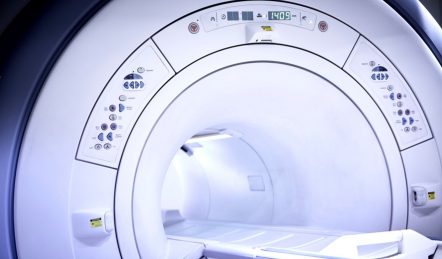
An MRI browse may give you a listing of various potential diagnoses, only it is not the be-all and end-all in itself, as it's important to 'care for the patient, not the picture'. However, the old adage of 'expect before you bound' is highly apposite hither, and you can't see without looking. So, if you lot recall you might have a knee problem, and so become it checked out! See a proper specialist and get some decent imaging: if it's all fine, then great. If there's something wrong, then the sooner you lot know and the sooner you lot deal with it, the improve!
Look after your knees!!
Oryon Imaging
We offer affordable diagnostic imaging in London's world-renowned Harley Street medical district. If you lot or a patient need a scan, we're an efficient, affordable and quick selection, with private MRI scans from £200, Ultrasound from £265, X-ray from £55 and DEXA from £95.
Oryon Develop
If you lot're a healthcare professional who is interested in running injuries, and then check our marathon injuries webinar available on-demand.
About the writer

Mr Ian McDermott is a Consultant Orthopaedic Surgeon specialising purely in knees. He is the founder and the Managing Partner of the London Sports Orthopaedics practice, based in the centre of The Metropolis of London, and he is also an Honorary Professor Acquaintance in the School of Sport & Education at Brunel University.
Ian won the President's Medal of the British Association for Surgery of the Genu for his inquiry into meniscal repair, and he was awarded a Principal of Surgery higher degree by Imperial College for his research into meniscal transplantation. Ian has Hospital Innovations 'Centre of Excellence' status for meniscal transplantation, and he also has Vivostat 'Eye of Excellence' status for his utilise of biological glues in knees.
Ian has likewise pioneered the apply of custom-made articulatio genus replacements in the UK, and he is part of the Conformis Surgical Visitation Plan, teaching surgeons from beyond the Uk on the surgical techniques for custom-fabricated knee replacement surgery.
Ian was too the youngest always surgeon to exist elected as a Trustee and Council Member of the Regal College of Surgeons, he is currently the President of the Britain Biological Knee Social club, and he is besides the Vice-Chairman of the Federation of Independent Practitioners Organisations.
Ian has said that he would welcome any comments or queries relating to his article, or any queries on whatsoever other genu-related topic. He can be contacted via:
www.kneesurgeon.london
www.sportsortho.co.britain
Source: https://oryon.co.uk/blog/3-common-running-injuries/
0 Response to "Told Me I d Never Run Again Torn Cartilage"
Post a Comment